Tag: california

Subscription Lawyer Case Win!

A DUI charge reduced to Reckless Driving—protecting more than just a record, but a future. 

Through strategic defense and careful advocacy, we were able to secure a resolution that helps safeguard our client’s immigration application and long-term stability in the United States. Not every case is just about the immediate charge—it’s about the ripple effects on work, family, and immigration status. That’s why building the right defense strategy from the start matters. 

Un cargo por DUI reducido a conducción imprudente: protegiendo no solo un historial, sino un futuro.

Mediante una defensa estratégica y una representación diligente, logramos asegurar una resolución que ayuda a salvaguardar la solicitud de inmigración de nuestro cliente, así como su estabilidad a largo plazo en los Estados Unidos. No todos los casos giran únicamente en torno al cargo inmediato; se trata también de las repercusiones en el ámbito laboral, familiar y en el estatus migratorio. Por ello, resulta fundamental construir la estrategia de defensa adecuada desde el primer momento.

Chicago Rapid Response Groups Adapt as Immigration Enforcement Continues 

Community organizations across the Chicago area are adjusting their strategies as immigration enforcement operations continue at a lower profile throughout 2026. According to a recent analysis by WBEZ and the Chicago Sun-Times, hundreds of people were detained in the Chicago area during the first months of the year, even as large-scale public enforcement actions became less visible. Local rapid response groups say they remain on alert and are focusing on faster communication, neighborhood coordination, and expanded “Know Your Rights” training efforts. Organizations including Pilsen Unidos por Nuestro Orgullo and Casa DuPage Workers Center have been working with volunteers to monitor enforcement activity and share information with community members. Organizers say enforcement tactics have shifted in recent months. Rather than highly visible operations, some groups report seeing more targeted arrests, making it more difficult for volunteers to respond quickly. In response, community organizations are using updated dispatch systems, local text chains, and neighborhood-based communication networks to improve response times.  

Advocates are also increasing training efforts to help individuals better understand their legal rights during encounters with immigration authorities. Many sessions now include information about warrants, detention procedures, emergency planning, and access to legal representation. Some organizations say they are also preparing volunteers for potentially more aggressive enforcement situations by offering de-escalation guidance and safety-focused training. Community leaders emphasize that preparation and access to accurate legal information remain important for families navigating uncertainty around immigration enforcement. As immigration policy debates continue nationwide, Chicago-area advocacy groups say they expect rapid response efforts and community education programs to remain active throughout the coming months.

Las organizaciones comunitarias de toda el área de Chicago están ajustando sus estrategias a medida que las operaciones de control migratorio continúan desarrollándose con un perfil más bajo a lo largo de 2026. Según un análisis reciente realizado por WBEZ y el Chicago Sun-Times, cientos de personas fueron detenidas en el área de Chicago durante los primeros meses del año, incluso cuando las acciones de control público a gran escala se volvieron menos visibles. Los grupos locales de respuesta rápida afirman que se mantienen en estado de alerta y se están centrando en agilizar la comunicación, coordinarse a nivel vecinal y ampliar sus iniciativas de capacitación bajo el lema “Conozca sus derechos”. Organizaciones como Pilsen Unidos por Nuestro Orgullo y el Casa DuPage Workers Center han estado trabajando con voluntarios para monitorear la actividad de control migratorio y compartir información con los miembros de la comunidad. Los organizadores señalan que las tácticas de control han cambiado en los últimos meses. En lugar de operaciones de gran visibilidad, algunos grupos informan haber observado un aumento en las detenciones selectivas, lo cual dificulta que los voluntarios puedan responder con rapidez. En respuesta a esta situación, las organizaciones comunitarias están utilizando sistemas de despacho actualizados, cadenas de mensajes de texto locales y redes de comunicación vecinales para mejorar sus tiempos de respuesta.

Los defensores también están intensificando sus esfuerzos de capacitación para ayudar a las personas a comprender mejor sus derechos legales durante los encuentros con las autoridades de inmigración. Muchas sesiones incluyen ahora información sobre órdenes judiciales, procedimientos de detención, planificación para emergencias y acceso a representación legal. Algunas organizaciones afirman que también están preparando a voluntarios para situaciones de aplicación de la ley potencialmente más agresivas, ofreciendo pautas de desescalada y capacitación centrada en la seguridad. Los líderes comunitarios enfatizan que la preparación y el acceso a información legal precisa siguen siendo fundamentales para las familias que atraviesan la incertidumbre en torno a la aplicación de las leyes de inmigración. A medida que continúan los debates sobre políticas de inmigración en todo el país, los grupos de defensa del área de Chicago señalan que esperan que los esfuerzos de respuesta rápida y los programas de educación comunitaria se mantengan activos durante los próximos meses.

New Federal Law Cuts SNAP Benefits for 16,000 Legal Immigrants in Illinois 

The One Big Beautiful Bill Act, signed by President Trump on July 4, 2025, has taken effect earlier this month on April 1, 2026. This legislation has effectively barred many lawfully present non-citizens from SNAP during renewals. It has impacted immigrants that are legally in the United States including refugees and asylum seekers. Illinois officials estimate that around 16,000 people have been impacted by the act. Only certain long-term green card holders remain eligible, while undocumented immigrants were never eligible in the first place. Food pantries grow concerned about hunger spikes as they navigate these changes. 

La Ley “One Big Beautiful Bill” —firmada por el presidente Trump el 4 de julio de 2025— entró en vigor a principios de este mes, el 1 de abril de 2026. Esta legislación ha excluido, en la práctica, a muchos no ciudadanos con presencia legal del programa SNAP durante el proceso de renovación de beneficios. La medida ha afectado a inmigrantes que se encuentran legalmente en los Estados Unidos, incluidos refugiados y solicitantes de asilo. Las autoridades de Illinois estiman que alrededor de 16.000 personas se han visto afectadas por esta ley. Solo ciertos titulares de la tarjeta de residencia permanente (green card) con antigüedad conservan su elegibilidad, mientras que los inmigrantes indocumentados nunca fueron elegibles en primer lugar. Los bancos de alimentos expresan su preocupación ante un posible repunte del hambre mientras se adaptan a estos cambios. 

Illinois House Advances bill restricting immigrant detention centers in neighborhoods 

The legislation would ban immigration detention centers from being built near  community buildings. The decision is still awaiting senate approval. This would prohibit the construction of these facilities within 1,500 feet of schools, churches, day care centers, cemeteries, public parks, forest preserves, private residences and public housing. This policy would not impact pre-existing detention centers. 

The bill was sponsored by house speaker Emmanuel “Chris” Welch, who represents the Broadview area. He claims the legislation is a product of the experience of the local community. He advocated for distancing this disruption of chaos from the places where people frequently worship, play with their children, and live.  

Republican pushback refers to California policy, which was a ban struck down in federal court. House speaker Welch remains confident in his legislation, arguing that rather than proposing a ban, they are working with the federal government to protect the local communities at stake.  

Chicago area officials accuse ice of violating Illinois law 

In October, Governor J.B. Pritzker signed an Illinois law prohibiting ICE agents from  executing civil warrants at courthouses. The Cook County chief judge also passed an order stating the same rule.  

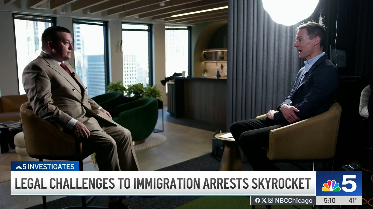
Chicago area leaders have accused Immigration and Customs Enforcement of  carrying out arrests at the Cook County Domestic Violence Courthouse in defiance  of this law. Senator Garciela Guzmán is among those leaders speaking out In a statement, she emphasized the democratic importance to ensure that people of all parties can attend court without a target on their back. 

According to Cook County Board President Toni Preckwinkle, she and others are working with the Cook County Sheriff’s Department to determine how ICE agents can be held accountable.  

Texas House Democrats Leave for Illinois to Block Republican Redistricting — Texas Governor Greg Abbott Wants Them Extradited Back  

This week’s Legal Definition of the Week and national news overlap as we cover the case of the Texas House Democrats that have fled to Illinois. 

On Aug. 3, many of the 62 Texas House Democrats fled the state to Illinois to block the voting of a redistricting map Republicans made. According to CBS News, Texas created the maps redistricted for Republican’s advantage after Trump had suggested in July. 

The map is intended to likely get Republicans five extra seats in the U.S. House next year and for the upcoming midterm elections. This is done by including conservative voters into districts that are predominantly Democrats without effecting other Republican districts through a process known as “gerrymandering”.  

The Texas House is made up of 150 lawmakers, and 100 of them need to conduct business, making any actions forward with the redistricting gridlocked.    

In an article published by NPR, Democratic Rep. Greg Casar of Austin, TX points out how this merging of districts goes against Black, Latino and other POC voters as well as the Voting Rights Act of 1965. 

Texas Governor Greg Abbott has also said he will use his “extradition authority” to demand that the Texas House Democrats are sent back to Texas.  

On Aug. 7, the FBI was requested by Senator John Cornyn to locate the Texas House Democrats.   

Trump Fires 17 Immigration Judges Nationwide

Since Jul. 17, Trump has fired 17 immigration court judges around the U.S. 

According to a news release by the International Federation of Professional and Technical Engineers (IFPTE), the union representing international court judges, 17 judges were fired “without cause”. The judges were from across ten different states, including Illinois, California Massachusetts, New York and Texas.  

All 17 of these recently fired judges were women.  

Judge Jennifer Peyton, Assistant Chief Immigration Judge of Chicago was fired via email over the 4th of July weekend earlier this month.  

ABC 7 Eyewitness News reported that Peyton said her performance reviews have been consistently excellent and that she also received the Director’s Award from the Executive Office for Immigration Review. 

The IFPTE union also stated that over 100 judges were either fired or resigned since the beginning of 2025 and the Trump Administration, leaving approximately 600 immigration court judges to serve over 3.5 million current immigration cases.  

More information regarding this situation can be found online.  

Legal Definition of the Week

Check out our latest edition of Legal Definition of the Week! This week’s legal definition: “Arriving Alien”

**Disclaimer: **Recent efforts have been made by individuals and groups to change the official U.S. Immigration legal term from “alien” to “noncitizen”**

ABOUT SUBSCRIPTION LAWYER

What Our Clients Are Saying...

How It Works

WE MAKE IT EASY

STEP 1

​Make your initial deposit of

ONLY $500

and become a Subscription Lawyer client. Contact us to sign up!

STEP 2

Receive Benefits:

STEP 3

​Receive discounts on select legal services, sometimes up to 50%!

News / Videos

Have Questions? We are here to help!

Ready to Sign Up? Contact Us!

Scroll to Top